The website trap
Our own website took about two months, and for the first month nobody wrote a line of code.
Every team that builds its own website walks into the same trap. We had seen it in the companies we worked for, at friends’ companies, in their side projects. Nobody is there to say “that’s enough.” You look at the site every day, you get tired of what you see, and you rebuild it. It ends up taking three times longer than planned, and it brings in no extra clients.
A design studio’s site has to stun, because the site is the work. Ours has one job. We integrate AI into businesses, so a business owner needs to understand what we do in a few seconds. Knowing that didn’t stop us from wanting animations everywhere.
So we fell in too. The work we do for clients runs on deadlines someone else holds. Our own website had none, and it took about two months.
A month without code
For the first month, nobody wrote a line of code. No framework, no design, no build. The three of us are engineers, and for a month we did everything except engineering: marketing, sales, brand, and how to talk to someone who isn’t technical.
Eddie started first, while the other two of us wrapped up other work. For about three weeks he took in everything he could on marketing, brand and positioning, with AI to go faster. Then we went through every past mission together. What worked, and why. Which offers fell flat. What clients asked us that we couldn’t answer.
The books we kept coming back to:
- Positioning and selling
- Obviously Awesome, April Dunford
- Win Without Pitching, Blair Enns
- The Four Conversations, Blair Enns
- Hourly Billing Is Nuts, Jonathan Stark
- The website
- Making Websites Win, Karl Blanks and Ben Jesson
- Building a StoryBrand, Donald Miller
- Don’t Make Me Think, Steve Krug
- The brand
- Logo Design Love, David Airey
None of us was comfortable with any of this, which is exactly why it was worth doing.
We had been here before. A while back, two of us built Voltaire, a writing tool with AI inside. We wanted it to speak to everyone, and every conversation ended on the same question: what does it do that ChatGPT doesn’t? We never had a clean answer, because we had never decided who it was for.
This time the questions came before the site. Who we work for, which problems we solve, why us, what we say when someone asks how we’re different. By the end of the month we had an answer to most questions anyone asks us, and every page of the site is built on those answers.
What we dropped
Part of that month was lost, and we know why. We started from what we believed about our market: who buys from us, what they need, what they would pay. We built a first offer on top of it without checking any of it against the market. It came out wide, an offer for everyone, the generalist shop we had agreed not to be. It was the Voltaire mistake again.
What fixed it was the market analysis we had skipped: who actually has the problem, what they already tried, who else sells to them. With our past clients on the table, the target narrowed to business owners with a problem that costs them every month. Skipping that step cost us about three weeks.
The visuals went through the same filter. We started with origami and pencil doodles, a hand-drawn look we all liked. Making it ours took a lot of work, and it never said what we wanted it to say. It looked playful, and we wanted trust.
So we went back to what we do. We use AI to cut a business’s costs, inside the company or with a system built from scratch. One side of that is speed, software, machines. The other side is people: we stay with the client, they see everything, they understand what is being built.
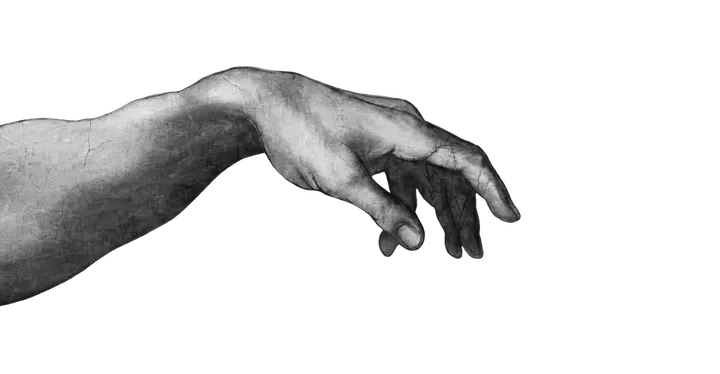
Two hands say that. On the home page, a human hand and a machine hand reach for each other. The human one is drawn fine. The machine one is made of dithered pixels, and that dithering became the mark of the machine on every illustration of the site. For color, we kept to neutrals, white to black through the grays.
The logo took longer. Yvan sent proposals for two weeks, and it got settled the day the three of us sat in the same room. We chose the octopus. It adapts to any environment, and it’s one of the few animals that uses tools, which is how we work for clients, and how an AI gets things done once it has the right tools. It also has three hearts. There are three of us, and we intend to keep it that way.
Two months, honestly
The first month, we worked in sequence, all three on the same things: content, brand, image. Then we split. Eddie polished the content while the other two of us started the site, and the three of us finished it together.
Having the content first is what made the build fast. Before drawing a page, we knew exactly what it had to say.
We still did the thing this article is about. Some sections got built once, then built again. Nobody was on it full-time, each of us had other work, and we live in different time zones, so everything ran in writing. With no client holding the deadline, one of us had to hold it, and kept saying it out loud: we decide this, we decide that, we ship.
From mid-August to mid-October: about two months. Measured against the deadlines we hold for clients, that’s slow, and we’d rather say so.
What we take from it
The three of us now speak a language we didn’t speak in August: brand, positioning, how a business owner reads a page. Our workflow came out sharper too. It had been a long time since we had watched each other work, and those days together gave us a list of things to change in how we build.
The site is live. We’re back on the market, with a site that says in a few seconds what we do and who we do it for.